What are common osteria menu items?
A plain-English guide to what actually appears on a Roman osteria menu, from the four classic pastas to quinto quarto offal dishes, wine by the carafe, and what the law says about the coperto.
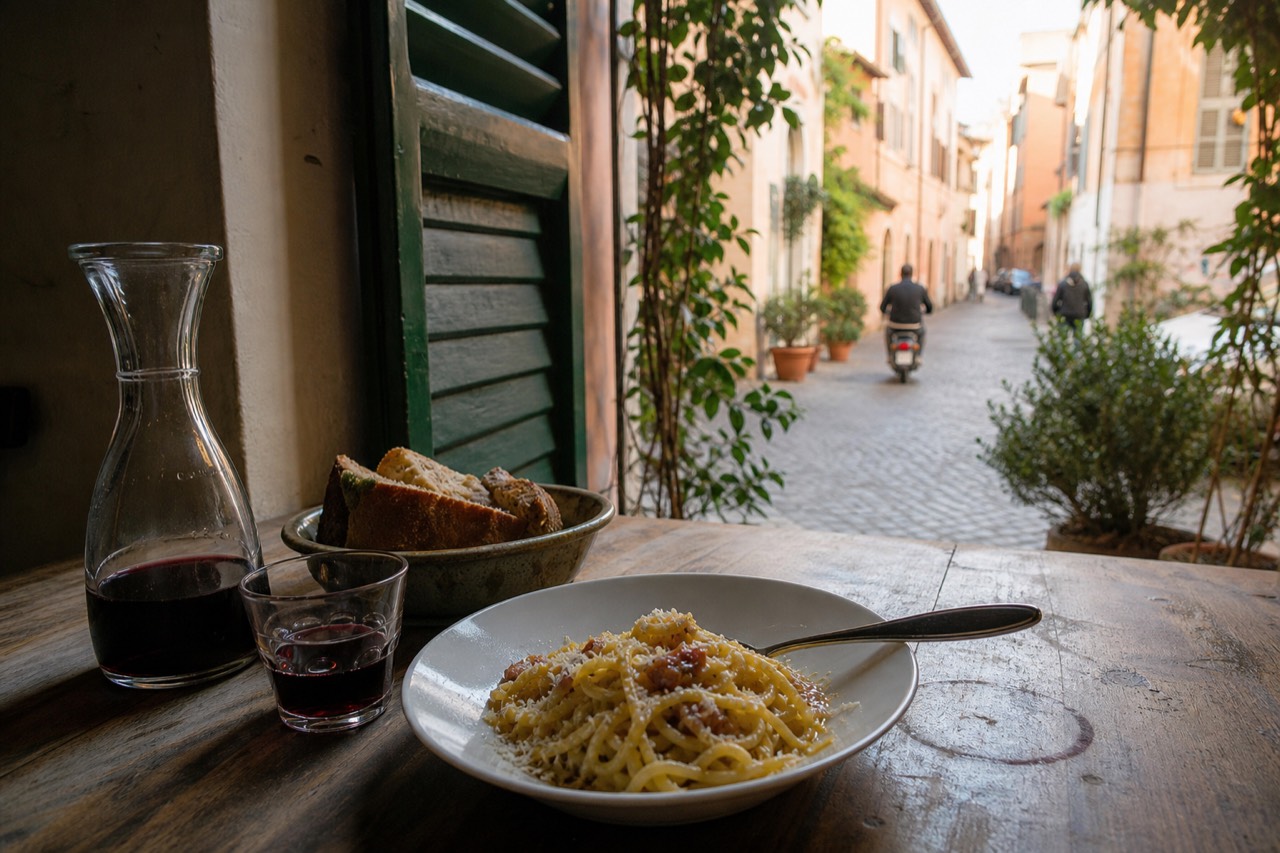
Roman osterias keep their menus deliberately short: a handful of pastas, a rotating block of offal and slow-cooked secondi, two or three contorni, cheese, and wine poured by the carafe or glass rather than by the bottle list. The word osteria comes from the Latin hospes, the same root as host and hospitality, and historically the osteria was the wine-first establishment, the place you went to drink with a little food alongside. That wine-first logic still shapes the menu you will be handed in Rome today, and it explains why the list rarely runs past a single page. This site, Rome Food Tours, covers the whole eating side of the city, and the osteria is the format where most of it starts.
What are common osteria menu items?
Common osteria menu items in Rome are the four classic pastas, carbonara, cacio e pepe, gricia and amatriciana, followed by quinto quarto offal dishes such as trippa alla romana, pajata and coda alla vaccinara, plus fried artichokes or baccalà, simple contorni, a cheese board, and house wine served by the carafe or glass. Dessert is minimal and coffee is espresso taken standing at the bar.
The menu usually opens with antipasti, and in a Roman osteria that means a short list rather than a long one. You will typically find cured meats and cheeses, a plate of baccalà filetti, fried cod, supplì, the fried rice balls with mozzarella and often a ragù filling, and in season carciofi, artichokes prepared either alla romana, braised with Roman mint, or alla giudia, the deep-fried whole artichoke of the Jewish quarter. Roma Capitale's own tourism portal names carciofi alla giudia, filetti di baccalà and tortino di aliciotti e indivia among the specialities of the city's Jewish tradition, and those dishes cross over freely onto osteria menus across the center.
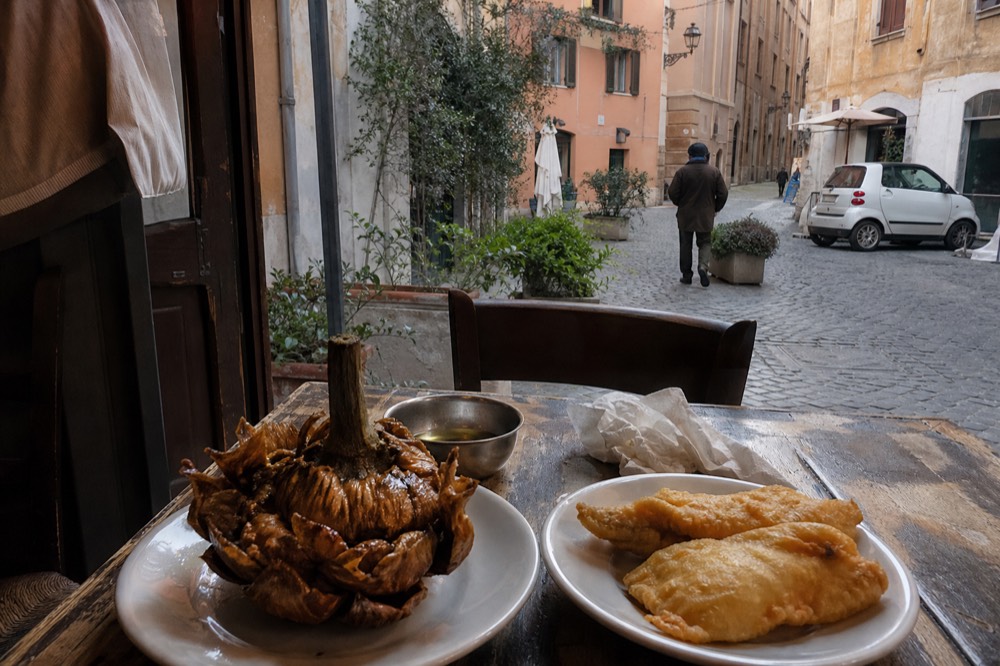
Then come the primi, and this is where the Roman osteria is most itself. The four canonical pastas, carbonara, cacio e pepe, gricia and amatriciana, appear in some form almost everywhere, and around them rotate seasonal pasta dishes, gnocchi on Thursday, lasagne or abbacchio-based ragùs, and whatever the kitchen bought at the market that morning. Amatriciana is the one dish on that list with a confirmed European registration: Amatriciana Tradizionale holds TSG status under Commission Implementing Regulation (EU) 2020/395, and the published specification pins the sauce to 18 to 30 per cent Amatrice pork jowl, guanciale, with tomato, olive oil and grated pecorino, stating plainly that it "has always been made with pork jowl, never bacon or pork belly". When an osteria menu says amatriciana, that is the tradition it is invoking.
The secondi section is where the osteria shows its Testaccio and Trastevere working-class roots. This is quinto quarto territory, the fifth quarter, the offal and lesser cuts that slaughterhouse workers once took home in place of wages, and it is the subject of a later section here. Alongside it you will find abbacchio, Roman lamb, usually roasted or in a pan, saltimbocca alla romana, veal with prosciutto and sage, and in winter the braised oxtail dish coda alla vaccinara.
Contorni are almost always potatoes, bitter greens such as cicoria ripassata, and in season puntarelle, the Roman chicory shoot salad dressed with anchovy, garlic and vinegar. Dolci run to tartufo, tiramisù, crostata and sometimes visciole jam crostata in the Jewish-roman style. Coffee is espresso, and Romans drink it at the bar, not at the table, after the meal rather than with it.
How is an osteria different from a trattoria or ristorante?
An osteria is wine-first with a short, kitchen-led menu, a trattoria is a family-style restaurant with a fuller home-cooking menu and table service, and a ristorante is a full-service restaurant with printed menus, courses and a wine list. In Rome the osteria keeps the shortest menu of the three and the strongest wine culture, while the trattoria covers the classic Roman dishes in more depth.
The distinction is real and Romans still make it, even if the lines have blurred as osterias have added kitchens and trattorias have added wine lists. The original osteria sold wine and almost nothing else: you brought or bought food, and the osteriante poured. Over the twentieth century most Roman osterias became small restaurants, but the wine-first inheritance survives in the house carafe, the short menu and the standing-room bar area many of them still keep. The trattoria, by contrast, was always a kitchen, a family serving its own cooking at shared tables, which is why the trattoria menu is longer and more dish-focused.
The ristorante is the formal tier: printed menus, more courses, a proper wine list, tablecloths and a coperto-style service culture that, in Lazio, actually has legal limits, which we come to below. If you want a deeper dish-by-dish read of the trattoria side of this split, our piece on typical trattoria menu items works through the full family-restaurant menu in Rome, and this page stays on the osteria's own ground.
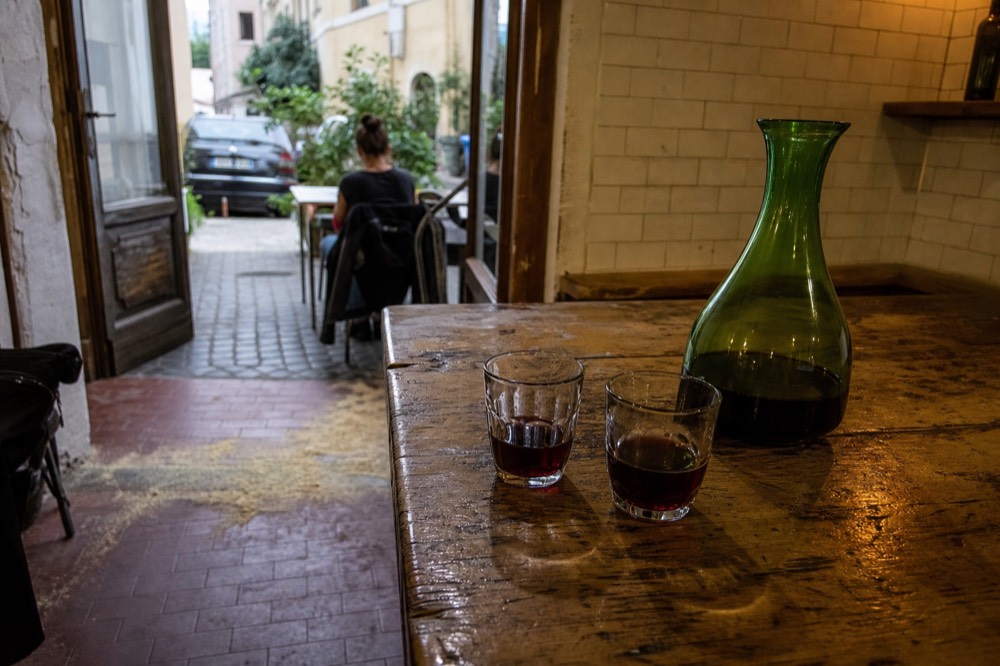
A practical way to tell them apart on arrival: the osteria will offer vino della casa by the carafe or quartino, often written on a board rather than a list, and the menu will fit on one page or a chalkboard. The trattoria will hand you a laminated card with dozens of dishes. The ristorante will hand you a booklet. None of these is the better experience; they are different formats, and Rome keeps all three because each does a different job on a different evening.
Which Roman pasta dishes appear on osteria menus?
The four pastas that anchor nearly every Roman osteria menu are carbonara, cacio e pepe, gricia and amatriciana. Carbonara is the most ordered, 46.1 per cent of Italians named it their favorite pasta in a survey for Carbonara Day 2026, and amatriciana is the only one of the four with a formal European TSG registration that specifies its ingredients.
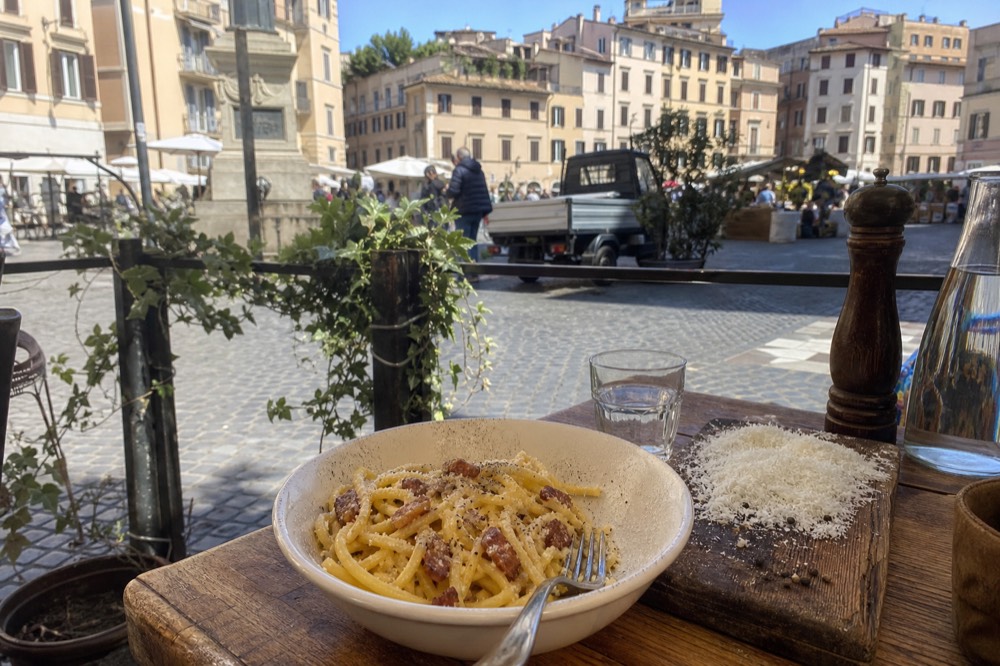
Carbonara needs no introduction, but its ingredient discipline is worth knowing before you order. The Roman versions use guanciale, cured pork jowl, egg, pecorino romano and black pepper, and there is a whole argument about cream that Romans settled long ago: no cream. Cacio e pepe is the minimal one, pasta, pecorino and black pepper, and it is the dish most often ruined in execution, because the cheese must melt into a cream rather than clump. Gricia is essentially carbonara without the egg, guanciale and pecorino, and amatriciana adds tomato to that base.
The pecorino in all of these is Pecorino Romano PDO, a registered European designation whose specification requires exclusively sheep's milk, maturing of at least five months for table cheese and eight for grating, and production between October and July across Lazio and Sardinia. The EU's published single document for the cheese sets all of this out, and it is why the pecorino on a Roman osteria menu tastes sharper and saltier than the milder pecorino toscano some visitors expect.
| Pasta dish | Core ingredients | What to know when ordering |
|---|---|---|
| Carbonara | Guanciale, egg, pecorino romano, black pepper | No cream in the Roman version; the sauce is emulsified egg and cheese |
| Cacio e pepe | Pecorino romano, black pepper | The hardest to execute well; order it at a busy osteria |
| Gricia | Guanciale, pecorino romano | The oldest of the four, essentially carbonara without egg |
| Amatriciana | Guanciale, tomato, pecorino romano | The only one with a European TSG registration specifying the sauce |
Beyond the four, osteria primi rotate with the Roman week. Gnocchi on Thursday is the custom most visitors encounter first, and it is a real one rather than a tourist invention, though the dish-by-dish detail belongs to our trattoria menu page. In autumn and winter, pasta with porcini or truffle appears, and Lazio has a legal truffle calendar behind that: the region's 1988 truffle law sets the harvest window for the prized black truffle from 15 November to 15 March and for the white truffle from 1 October to 31 December, which is why those flavours show up on menus in those months and not in July.
What does quinto quarto mean on a Roman menu?
Quinto quarto, the fifth quarter, is the Roman term for the offal and lesser cuts of the animal, tripe, oxtail, sweetbreads, pajata, coratella and kidneys, that slaughterhouse workers in Testaccio once took home as part of their pay. On an osteria menu today it appears as trippa alla romana, coda alla vaccinara, pajata and similar dishes, and Roma Capitale documents the tradition directly.
The city's own tourism portal explains that tripe, like oxtail, coratella and pajata, belongs to the quinto quarto, the least prized part of the animal, eaten in the past by the poorest families and above all by the workers of the Mattatoio, the Testaccio slaughterhouse built between 1888 and 1891, who topped up their wages with the offcuts left from the more prized cuts. That is the primary source for the tradition, and it is the reason the osteria menu and the slaughterhouse district grew up together: the osterias of Testaccio cooked what the workers brought through the door.
Trippa alla romana is the classic entry point. The same Roma Capitale page records it as a very old dish of the city's cuisine, traditionally eaten at Saturday lunch, as still happens in many trattorias of Trastevere and Testaccio, with a recipe that calls for strictly fresh ingredients, two of them exceptional: pecorino romano and Roman mint. Coda alla vaccinara, oxtail braised for hours with tomato, celery and often a touch of cocoa or clove, is the richer, darker cousin. Pajata, the intestine of the milk-fed lamb, is the one that tests visitors most, and it is usually served with pasta.
If you want to eat this end of the menu in its home district, our Testaccio food tours guide covers the neighborhood where the tradition was born, including the market and the ex-slaughterhouse quarter that produced it. An osteria in the center will serve you a competent trippa, but Testaccio is where the dish still has its social context.
What do osterias charge, and is the coperto legal in Rome?
In Lazio, an osteria may not add a separate coperto charge, and any table-service component must appear on the price list you can see before ordering, under regional law 21/2006, article 16, with fines of 2,500 to 7,500 euros for breaches. Osteria prices run below ristorante prices, and house wine by the carafe remains the budget wine format in the city.
The coperto rule surprises visitors who have eaten elsewhere in Italy, where the bread-and-cover charge is normal and legal. In Lazio it is not. Article 16 of the regional law on food and drink service, in the coordinated text published by the Consiglio Regionale del Lazio, states that where service is at the table, the price list must be available before ordering and must show any service component clearly, and then, verbatim, it prohibits applying additional costs for the coperto. The honest caveat: the law is the rule, not a guarantee of compliance, and if a menu in the center shows a coperto line, you now know what the position is.
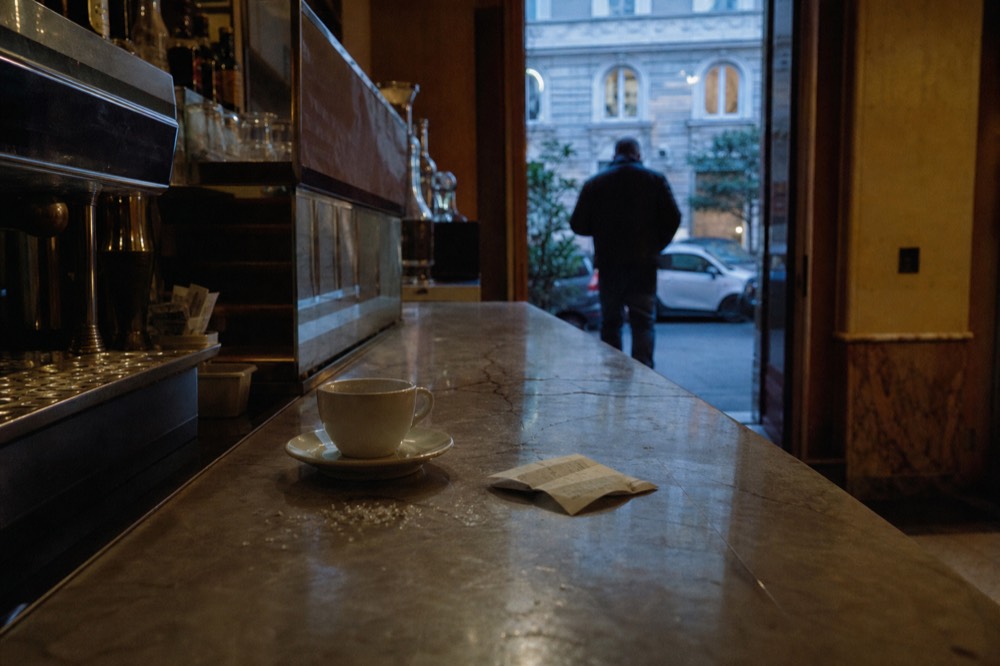
For everyday prices, the FIPE Ristorazione 2026 report, the annual publication of the Italian federation of restaurants and bars, put the average espresso at the counter in Rome at 1.35 euros in December 2025, based on ISTAT data. A separate 2026 study on Mimit price-observatory data put the Rome province average below 1.20 euros, but the two measure different areas and periods, so cite one, not a blend. Nationally, restaurant services inflation ran at about 3.2 per cent in 2025 per the same FIPE report, so osteria prices have drifted up, but the format remains the cheapest full meal in the city.
| Menu section | Typical osteria approach | Rough expectation |
|---|---|---|
| Antipasti | Supplì, baccalà, cured meats, fried artichokes in season | A few euros per item, meant to share |
| Primi | The four pastas plus weekly rotation | The core of the meal, mid-range per plate |
| Secondi | Quinto quarto dishes, abbacchio, saltimbocca | The priciest section, still below ristorante level |
| Wine | House wine by carafe, quartino or glass | The cheapest wine format in Rome |
| Coffee | Espresso at the bar after the meal | Around the city's average espresso price |
House wine deserves a word, because it is the osteria's founding product. The carafe on the checkered tablecloth is not a compromise, it is the point, and in Rome it is often Castelli Romani wine, the Frascati and Marino whites grown in the hills twenty minutes south of the city. Lazio's 2025 harvest produced 764,000 hectolitres of wine, up 5 per cent on 2024 per ISMEA data reported by Coldiretti Lazio, and Gambero Rosso's Vini d'Italia 2026 guide awarded 11 Tre Bicchieri to Lazio wines, so the region's reputation is climbing even as the everyday carafe stays humble.
Can you taste the osteria's wine tradition on a tour?
Yes: the Private Castelli Romani Wine Tasting Tour runs about 3 hours with hotel pickup and takes you into the Castelli Romani hills where Rome's osteria house wines are grown, rated 4.5 from 47 reviews at $97.55 per person. It is the natural extension of an osteria evening, moving from the carafe on the table to the vineyards it came from.
The connection is genuine rather than decorative. The whites that fill Roman carafes, Frascati, Marino, Colli Albani, are all Castelli Romani denominations, and the consortium for Cesanese di Olevano Romano, Lazio's flagship red, was formally recognised by the Ministry of Agriculture in September 2025. Drinking them at the source, in the towns above the volcanic lakes, is a different experience from drinking them in Trastevere, and the private format suits travelers who want the winery story rather than a group schedule.
For travelers who prefer to stay in the city, the osteria tradition also feeds the premium end of the food tour market. The luxury Trastevere tour pairs free-flowing fine wine with the neighborhood's food culture over 4 hours, rated 5.0 from 3,492 reviews, and the gourmet dinner tour with Barolo runs 3.5 to 4 hours with a full seated dinner, rated 4.9 from 2,676 reviews. Both are covered in our private and VIP food tours guide, which compares the formats side by side.
Do osterias serve dessert and coffee?
Dessert at a Roman osteria is a short list: tiramisù, tartufo, crostata and sometimes panna cotta, and coffee is espresso taken standing at the bar after the meal rather than at the table. Digestivi such as limoncello, grappa or amaro are commonly offered at the end, sometimes on the house.
The dessert list is short for the same reason the whole menu is short: the osteria is not a pastry shop. Tartufo, the chocolate-covered ice cream ball from nearby Calabria, has been adopted by Roman osterias as a convenience dessert, and crostata, the jam tart, is the house-made option. In the Jewish-roman corner of the menu, crostata with visciole, sour cherry jam, and ricotta appears, and Roma Capitale names it among the quarter's traditional sweets.
Coffee culture is where visitors most often trip up. Romans do not order a cappuccino after a meal, and an osteria will serve one if asked, but the local rhythm is espresso, taken quickly, often at the bar while paying. The FIPE report shows colazione, breakfast at the bar, actually fell 2 per cent in visits in 2025 while lunch rose slightly, a sign that the bar-coffee habit is holding even as habits shift. Digestivi close the meal: limoncello, mirto, grappa or an amaro, and in a traditional osteria a small one sometimes arrives unasked, which is hospitality rather than an upsell.
That closing ritual, wine, food, a bitter glass and a quick espresso, is the whole osteria format in miniature, and it is why the menu never needed to be long. The osteria sells a way of eating, and the short menu is the mechanism. If you want the fuller family-kitchen counterpart, the trattoria menu page covers the dishes that format adds, and if you want to taste the wine end of the tradition in person, the Castelli Romani option above is the direct route.
The questions below cover the osteria menu in short form: what appears on it, how the format differs from a trattoria, what the coperto rules are in Lazio, and how quinto quarto, house wine and the coffee ritual work in practice. Each answer is drawn from the sections above.
Common questions about osteria menu items
What are common osteria menu items?
Common osteria menu items in Rome are the four classic pastas, carbonara, cacio e pepe, gricia and amatriciana, quinto quarto dishes such as trippa alla romana and coda alla vaccinara, fried antipasti like supplì and baccalà, seasonal contorni, a short dessert list, and house wine by the carafe or glass.
Is an osteria the same as a trattoria?
No. An osteria is historically wine-first with a short kitchen-led menu, while a trattoria is a family-style restaurant with a fuller home-cooking menu and table service. In practice the lines blur, but the osteria keeps the shorter menu and the stronger house-wine culture.
Can a Rome osteria charge a coperto?
In Lazio, regional law 21/2006 article 16 prohibits a separate coperto charge, and any table-service component must appear on the price list before you order. Breaches carry fines of 2,500 to 7,500 euros, though the law is the rule, not a guarantee of compliance at every venue.
What is quinto quarto on a Roman menu?
Quinto quarto, the fifth quarter, is the Roman term for offal and lesser cuts, tripe, oxtail, pajata and coratella, traditionally eaten by the slaughterhouse workers of Testaccio. On osteria menus it appears as trippa alla romana, coda alla vaccinara and similar slow-cooked dishes.
Do osterias in Rome serve wine by the glass?
Yes, and by the quartino, a small carafe, as well as the glass. House wine is the osteria's founding product, and in Rome it is often Castelli Romani wine such as Frascati or Marino, poured from the carafe rather than chosen from a bottle list.
Should you order cappuccino after a meal at an osteria?
Locals do not. The Roman rhythm is espresso taken standing at the bar after the meal, with a digestivo such as limoncello or an amaro if the evening runs long. An osteria will make a cappuccino if you ask, but it is not the local custom.