what are common carbonara mistakes to avoid?
The four carbonara mistakes Roman cooking-class chefs correct most often, cream, bacon, scrambled egg and pan heat, and how to fix each one.
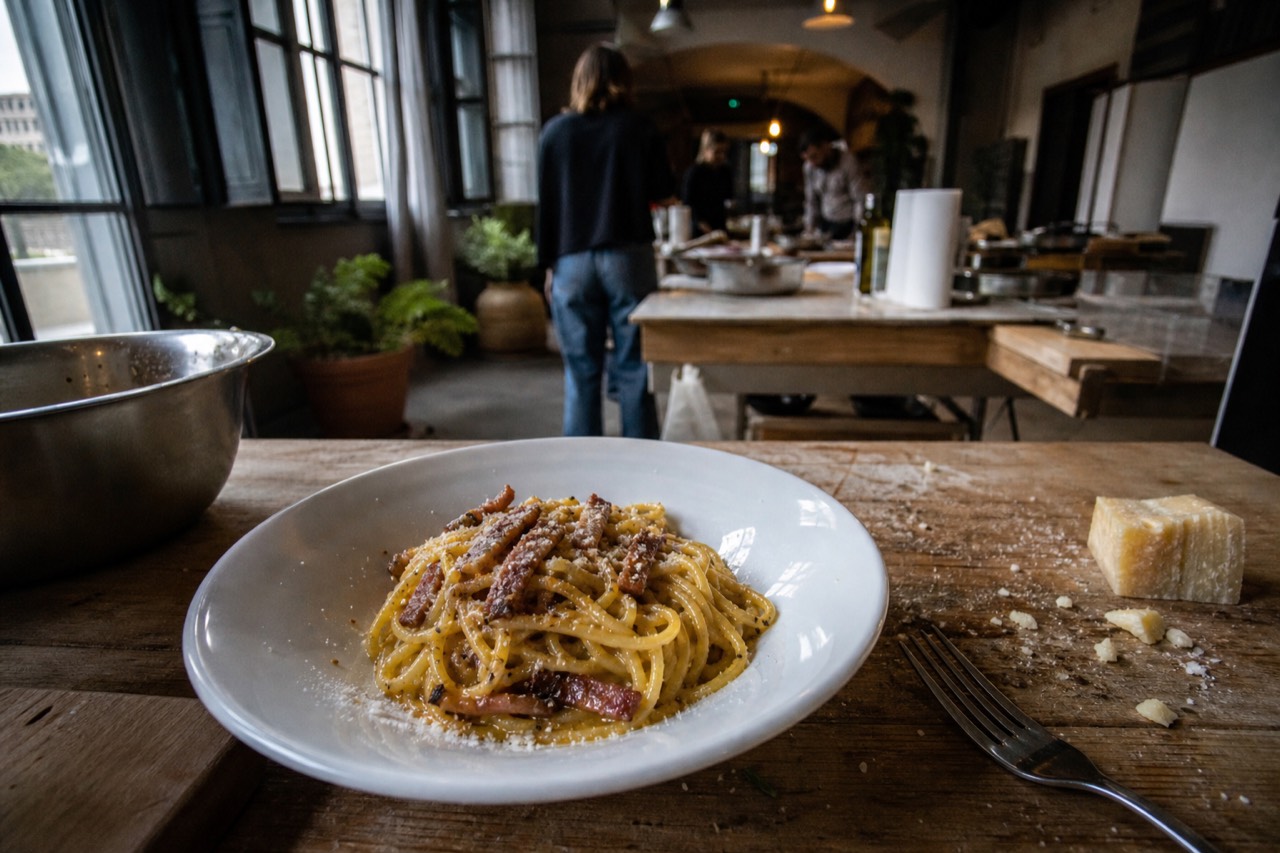
what are common carbonara mistakes to avoid?
The four mistakes Roman cooks correct most often are adding cream, substituting bacon for guanciale, letting the egg scramble into omelette strands, and working over heat that is too fierce. Each fault changes the dish's fat base or texture. Roman cooking-class chefs treat cream and bacon as the two definitional errors, and heat control as the technique that separates a sauce from scrambled pasta.
Ask a Roman cooking teacher what goes wrong most often and you will get the same short list, in roughly the same order. Cream comes first, because it is the mistake that travelled furthest from the original dish and is now baked into versions of carbonara served from London to Buenos Aires. Bacon comes second, because it is the substitution home cooks reach for when guanciale is hard to find. The scrambled egg comes third, and it is the one that ruins the most dinners, because it turns a silky sauce into something that looks like breakfast. Heat, salt and timing sit underneath all three.
None of these are obscure. What surprises most visitors who take a class in Rome is how mechanical the fixes are. There is no trick ingredient, no splash of mystery liquid, no family secret. Carbonara is four ingredients plus pasta water, and the entire craft lives in the order of operations and the temperature of the pan. That is good news for travellers: the dish is learnable in a single afternoon, which is exactly why carbonara is the dish most Rome cooking classes teach first.
The scale of the dish's popularity is easy to underestimate. An AstraRicerche survey released for Carbonara Day found that 46.1 per cent of Italians name carbonara their favorite pasta dish, ahead of every other pasta in the country, and delivery platforms have recorded hundreds of thousands of carbonara orders in Italy in a single year, with Rome leading every other city. When a dish is this loved, the mistakes multiply with it. A crowd-rated TasteAtlas ranking of spaghetti dishes published in November 2025 even placed Roman carbonara first in the world, which says less about rankings than about how far the dish now travels, mistakes included.
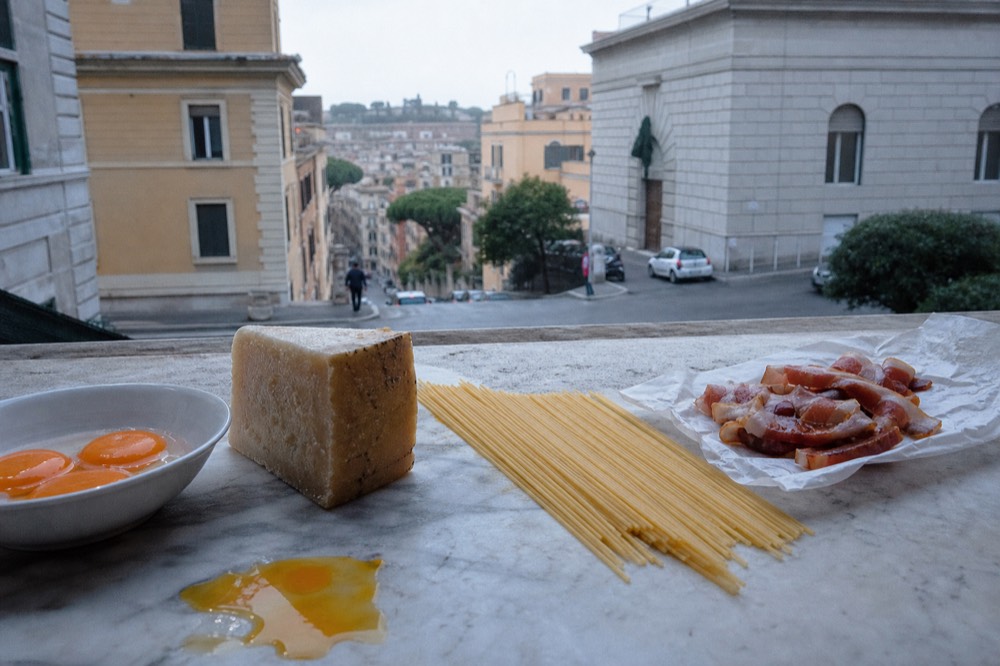
For anyone who wants the ingredient list spelled out before the fault list, the companion piece on the four carbonara ingredients covers guanciale, egg, pecorino and pepper in detail. This page is about what happens when those four things are handled badly, and what Roman cooks actually say when they correct it.
If you would rather be corrected in person than on a page, these three Rome experiences all put you in front of a cook who makes carbonara the Roman way:
Why does cream never appear in Roman carbonara?
Cream never appears in Roman carbonara because the sauce is already an emulsion: rendered guanciale fat, egg, pecorino and starchy pasta water bind into a glossy coating with no dairy cream needed. Roman chefs treat cream as a mask, it hides a sauce that has broken and flattens the sharpness of the pecorino. The fix is technique, not a replacement ingredient.
The cream question is the one Roman cooks answer most wearily, because the answer is structural rather than opinionated. Carbonara's sauce is an emulsion, the same physical thing as mayonnaise: fat suspended in water with egg proteins and cheese acting as the binders. Add cream and you are not enriching that emulsion, you are replacing it with a ready-made one. The dish stops being a built sauce and becomes pasta in cream with egg flavor.
The practical tell is in the cheese. Pecorino Romano is a salty, sharp, sheep's-milk cheese, and against a clean fat-and-egg emulsion its bite is the point of the dish. Against cream, that bite disappears, which is why cream versions of carbonara taste flat and need extra salt. The consortium for Pecorino Romano describes the cheese's own character in detail, and its sharpness is precisely what a cream-based sauce smothers. A Roman cook tasting a cream carbonara is not scandalised by a rule broken, they simply taste a dish where the main ingredient has been switched off.
There is also a history worth knowing, because it explains why the cream version is not a malicious invention. Restaurant kitchens outside Italy adopted cream in the twentieth century because it makes the sauce foolproof: cream will not scramble, it holds at any temperature, and it survives a heat lamp. It was a professional shortcut for a sauce that is genuinely hard to hold at service, and home cooks then copied restaurant menus. The Roman version never took the shortcut, which is why the dish stayed a home-cooking technique that restaurants had to relearn.
The fix, when a sauce breaks or looks thin, is not cream. It is pasta water, added a spoon at a time off the heat, worked into the egg and cheese until the mixture loosens and turns glossy. Every Roman cooking class teaches this exact move, usually twice, because the instinct to reach for a liquid that is already thick is strong. Starchy water is the correct thickener here because its starch helps the emulsion hold, something cream does by brute force instead.
Is bacon really wrong, or just not Roman?
Bacon is wrong for carbonara because guanciale, cured pork jowl, is the fat the dish was built on: it renders a soft, sweet fat that carries the egg and cheese. Bacon is smoked and leaner, so it gives a different flavor and less fat to emulsify. In Rome the swap reads as a different dish entirely, not a local variation on the same one.
Guanciale is pork jowl or cheek, dry-cured for at least a month, and it is the only cured meat in the classic Roman pasta family. The EU-registered specification for Amatriciana Tradizionale, the neighbouring sauce that shares guanciale with carbonara, states plainly that the sauce has always been made with pork jowl, never bacon or pancetta, and sets the guanciale content of that sauce at 18 to 30 per cent. Carbonara has no such registered specification, but Roman cooks apply the same logic: the jowl is the dish's fat source, and the dish has no other fat in it at all.
That last point is what non-Italian cooks miss. Carbonara contains no olive oil, no butter, no lard. Every drop of fat in the pan comes from the guanciale as it renders, and that fat is the liquid the egg and cheese emulsify into. Bacon, especially smoked streaky bacon, renders differently: less fat, more water, and a smoke flavor that Roman palates simply classify as belonging to another cuisine. The dish does not become bad with bacon, it becomes a different recipe wearing the same name.
Guanciale's own status is worth being precise about, because food writing gets it wrong in both directions. It has no protected designation of its own: a search of the EU's full geographical-indications register returns no entry for guanciale as a product. What is protected is how it is used in registered sauces, and the amatriciana specification pins its curing at a minimum of 30 days and its cut, a triangle from the throat with fat predominating over lean. For a fuller account of the meat and its American availability troubles, the article on why guanciale was banned in the US covers the import history.
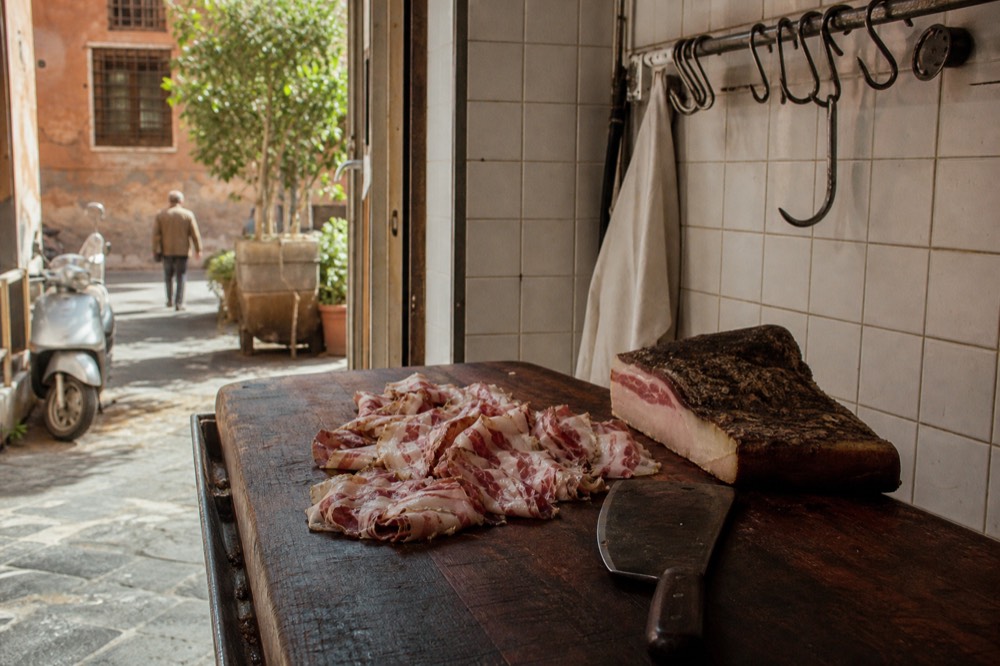
Finding guanciale outside Italy is genuinely hard, and Roman teachers know it, so the honest hierarchy they teach is: guanciale first, then pancetta as the accepted fallback, then bacon only as a last resort. Pancetta at least is unsmoked and cured in the same spirit, so the fat renders in a similar way even if the flavor is milder. Smoked bacon changes the dish's flavor profile outright, which is the difference between a substitute and a rewrite.
There is a supply-side wrinkle worth knowing while shopping: guanciale has had a complicated year. In early September 2026 the US food safety authority announced a recall of roughly 1,513 pounds of imported ready-to-eat Italian guanciale over possible listeria contamination, and in late August 2026 an African swine fever outbreak in wild boar at Riano, in Lazio itself, led the European Commission to establish an infected zone in the region. Neither event touches the cured product served in Roman restaurants, but both explain why imported guanciale in some markets has been patchy, and why a class in Rome is a reliable place to taste it.
Why do the eggs scramble, and how do Roman chefs stop it?
The eggs scramble when they meet metal that is too hot or pasta that has not been lifted off the flame first: egg proteins set almost instantly on contact with fierce heat and clump into solid curds. Roman chefs kill the flame, move the pan off the burner, and add starchy pasta water before the egg goes in, so the egg lands in a warm, diluted environment and turns to cream rather than curds.
This is the mistake that ends in the bin, and it is a pure technique failure. Egg yolk proteins begin to set at temperatures well below a rolling boil, and a pan that has just had pasta and guanciale in it holds a lot of residual heat. Pour beaten egg into that pan on the hob and you are cooking an omelette with spaghetti in it. The result is not a slightly imperfect carbonara, it is a different dish, dry and clumpy, with the sauce clinging in islands instead of coating every strand.
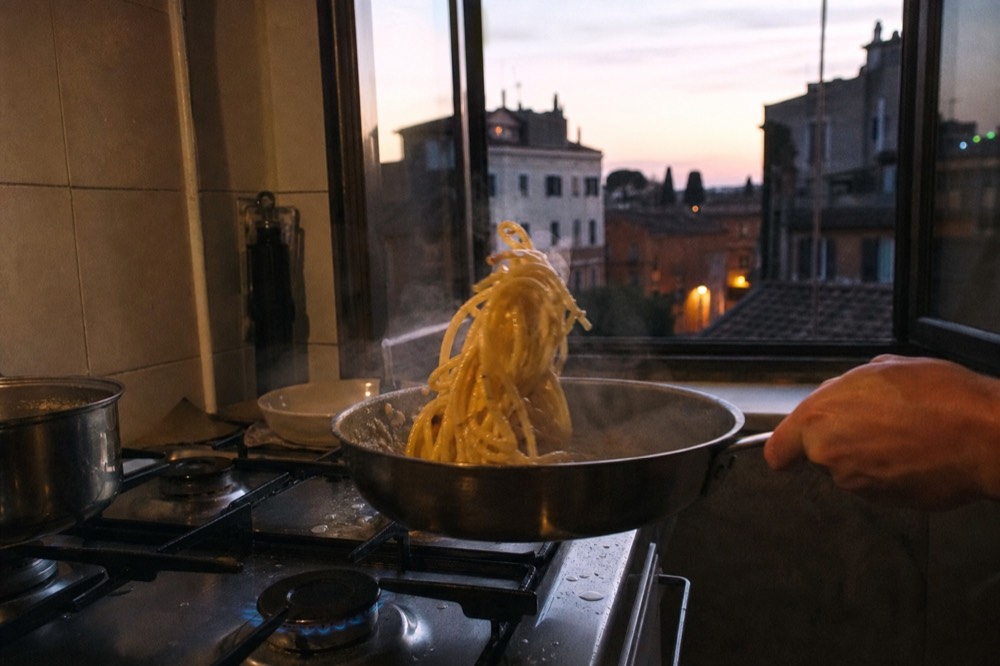
The Roman method is a sequence, and the sequence is the whole trick. First the guanciale is rendered gently until it is crisp and the fat is liquid, then the pan comes off the heat entirely. The raw pasta water splash goes in next, which drops the pan temperature and creates the starchy liquid the sauce will live in. The egg-and-cheese mixture is added to the pasta in that warm, not hot, environment, and everything is tossed fast so the egg disperses through the fat and water before it can set. What you get is a fine, glossy emulsion, and what you avoid is the scramble.
Two variations on the method exist and both appear in Rome. The classic home version uses whole eggs or a whole-egg-and-extra-yolk mix, tossed in the pan off the heat. The restaurant version, built for speed and hold, blends the egg with the pecorino into a smooth cream that can be ladled onto pasta at the pass. Both work. What does not work, teachers stress, is the middle path people invent: half the egg in the pan on the heat, half stirred in later. That produces both a scramble and a raw-flavoured sauce in one bowl.
The cheese timing belongs to the same discussion, because it fails for the same reason. Pecorino added to a hot pan seizes into stringy clumps that never re-melt, the same behaviour that ruins fondue. Roman cooks mix the pecorino into the beaten egg before anything touches the pan, so the cheese disperses into the liquid phase while everything is cold. Done that way, the cheese becomes part of the emulsion. Done in the hot pan, it becomes plastic.
What do Rome cooking classes correct first?
Rome cooking classes correct the same four faults in a fixed order: the ingredients first, then the pan temperature, then the cheese timing, then the pasta water ratio. Group pasta classes in Rome run from about $60 to $69 per person for roughly three hours with wine, and the fundamentals are identical across price points. The corrections happen in a booked class, not in a restaurant dining room.
The order is not arbitrary. Ingredients come first because no technique rescues smoked bacon or pre-ground pepper, so the class starts by putting the right raw materials on the counter and naming them. Pan temperature comes second because it is the failure that destroys the dish outright. Cheese timing and pasta water come last because they are refinements that only matter once the first two are stable. A teacher who reverses this order spends the class rescuing broken sauces instead of preventing them.
The Home Cooking in Testaccio class, run by CURIOSEETY from Via Galvani 4 in the slaughterhouse district, teaches all three classic Roman pastas, cacio e pepe, amatriciana and carbonara, in a real home kitchen, and carbonara is where the heat-control lesson lands hardest. It runs three hours at $93.47 per group, with the price varying by group size, and holds a 4.9 rating across 106 reviews. Because it is a home rather than a school, the corrections are the same ones a Roman relative would give: taste the guanciale, feel the pan, watch the egg.
Class sizes matter more than class prices here. In a small group the teacher can catch your pan at the exact moment it is about to be too hot, which is the moment the lesson exists. In a large demonstration you watch the correct moment instead of feeling it. Both formats teach the same recipe, but the correction, the thing this article is about, is a real-time intervention. That is the honest argument for a hands-on class over a video or a recipe card, and it is why taking a cooking class in Rome is worth considering even on a short trip.
Which pasta, cheese and pepper choices go wrong?
Spaghetti and rigatoni both work, but overcooked pasta, pre-ground pepper and pecorino thrown into a hot pan all cause failures. Roman cooks bloom coarsely ground fresh pepper in warm guanciale fat, keep the pasta firmly al dente, and mix the cheese into the egg while everything is still cold. These errors are small, cheap to fix, and easy to name once you have seen them.
The pasta itself is the least fussy choice in the dish, and Roman opinion on it is broader than tourists expect. Spaghetti is the international default, rigatoni is common in Rome because the tubes hold sauce, and bucatini has its defenders, though its hollow center can squirt hot egg mixture in unfortunate directions. What matters is the cooking: pasta for carbonara must be pulled a full minute before the package's al dente time, because it keeps cooking in the warm pan while the sauce is worked in. Overcooked pasta releases starch unevenly and turns the sauce gluey.
Pepper is where laziness shows. Pre-ground pepper is dust, and dust has no aroma. The Roman approach is to crack or coarsely grind black peppercorns and bloom them briefly in the warm rendered guanciale fat, so the pepper's volatile oils release into the fat that will carry the whole sauce. Some cooks toast the pepper dry first, then add the fat. Either way, the pepper is treated as a cooked ingredient, not a table condiment, and the difference is audible in the first bite.
| Mistake | What it does to the dish | The Roman fix |
|---|---|---|
| Cream in the sauce | Replaces the emulsion, flattens the pecorino, masks a broken sauce | Starchy pasta water, added off the heat, a spoon at a time |
| Bacon instead of guanciale | Smoke flavor, less rendered fat, a different dish | Guanciale, or unsmoked pancetta as the accepted fallback |
| Egg added over live heat | Proteins set instantly, sauce scrambles into curds | Flame off, pan off the burner, pasta water in first |
| Pecorino in a hot pan | Cheese seizes into stringy clumps that never re-melt | Mix cheese into the beaten egg while cold |
| Pre-ground pepper | No aroma, dusty texture | Coarse fresh-ground pepper, bloomed in warm fat |
| Pasta cooked to the packet time | Overcooks further in the pan, sauce turns gluey | Pull it a minute early, finish it in the sauce |
The cheese choice deserves one honest note: pecorino romano is the Roman cheese, but plenty of Roman cooks cut it with parmigiano to soften the salt, and a few use mostly parmigiano for children's plates. What no Roman cook does is use a mild cheese alone, because the dish needs some sharpness to stand up to the guanciale fat. Pecorino Romano matures a minimum of five months as a table cheese and eight months for grating under its EU-registered specification, and the older grating grade is what most Roman kitchens put in the bowl.
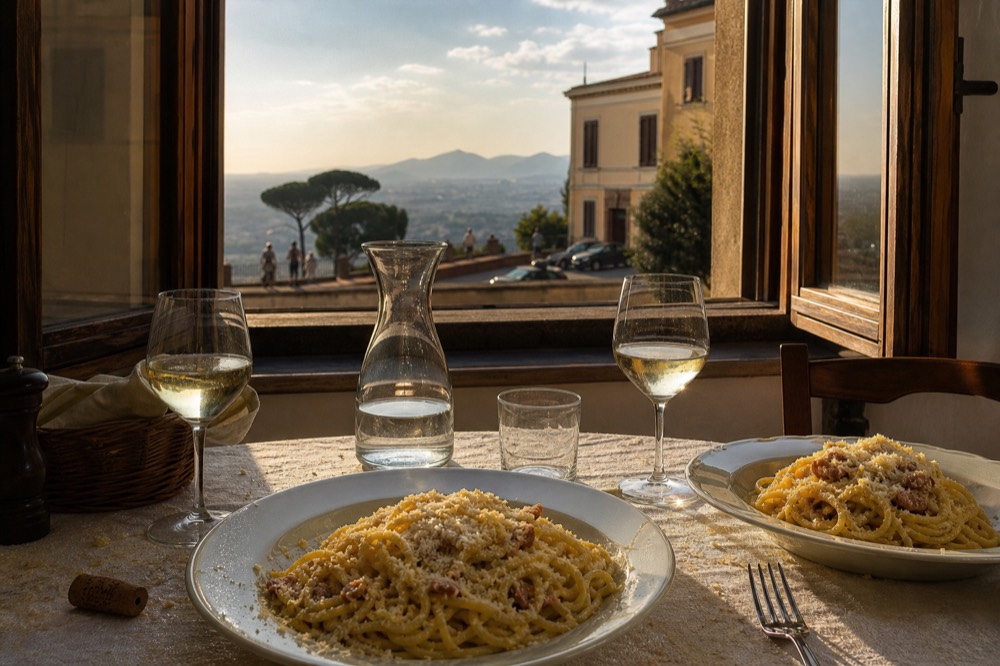
Salt is the quiet fifth fault, and classes flag it late for a reason: guanciale and pecorino are both heavily salted, so the pasta water needs less salt than usual and the sauce often needs none at all. Cooks who salt the water for a normal ragù strength, then add cheese and cured meat, produce a dish that tastes only of salt. Roman teachers have students taste the finished sauce before reaching for the salt, which usually means not reaching for it at all.
How much does a carbonara lesson in Rome cost?
Learning carbonara properly in Rome costs less than most visitors expect: group pasta classes run from about $60 to $69 per person for roughly three hours with wine included, and a private home-cooking lesson in Testaccio starts at $93.47 per group. The average advertised class price across Rome sits far higher, near $172, because premium formats pull the average up.
That average figure comes from an analysis of 198 advertised Rome cooking classes, and it is a useful reality check in both directions. If you are comparing a $68.52 class against a $250 one, the $68.52 class is not a suspicious bargain, it is close to the market floor for a legitimate hands-on group class, and the fundamentals it teaches are identical. If you are budgeting a whole trip, the average tells you that premium formats, private chefs, market visits and multi-course dinners, dominate the top of the market and can double or triple the price without changing what you learn about egg and heat.
The Pasta Making Class by the Pantheon, run by Pastamania from a cooking school on Via della Gatta 14, is the mid-market example: three hours, $68.52 per person, wine, dessert and limoncello included, rated 4.9 across 3,493 reviews. It teaches pasta from scratch, which adds a skill the pure carbonara lesson does not, and the sauce work covers the same Roman canon. The class's own page has the full details, and Check availability if a central location matters more to you than a neighborhood kitchen.
Timing the booking matters as much as the price. Rome recorded 22.9 million tourist arrivals and 52.92 million overnight stays in 2025, and the summer months alone drew over four million arrivals, so hands-on classes with small group sizes fill first, especially evening slots in the popular neighborhoods. Booking two or three weeks ahead is usually enough outside peak summer; in July and August, book the moment your dates are fixed. Classes run rain or heat, they are indoors, and a lunch class followed by a free afternoon is the pattern most visitors settle on.
Whichever class you choose, the dish you come home with is the same one this page has been about: four ingredients, one technique, and a short list of mistakes that every single one of these cooks has watched a thousand times. The whole point of learning it in Rome, on a site like Rome Food Tours rather than from a video, is that the corrections arrive at the exact moment your pan is about to prove why they exist.
If you are still choosing between formats, these are the three Rome experiences that cover the carbonara lesson best, from a home kitchen in Testaccio to a pasta school by the Pantheon:
The mistakes readers ask about most cluster around the same four faults: cream, bacon, scrambled egg and heat. The answers below cover each one in turn, plus the two questions that follow it home, the cheese timing and whether the gently cooked egg is safe to eat. Every fix comes from the same Roman sequence: right ingredients, flame off, pasta water, then egg.
Common questions about carbonara mistakes
what are common carbonara mistakes to avoid?
The four most common carbonara mistakes are adding cream, substituting bacon for guanciale, scrambling the egg by adding it over live heat, and over-salting on top of already salty cheese and cured meat. Roman cooks treat cream and bacon as definitional errors and heat control as the core technique, fixed by killing the flame and loosening the sauce with starchy pasta water.
Is carbonara really made without cream?
Yes. Roman carbonara is an emulsion of rendered guanciale fat, egg, pecorino and starchy pasta water. Cream appears in international restaurant versions because it makes the sauce foolproof, but it replaces the emulsion rather than enriching it and flattens the pecorino's sharpness.
Can I use bacon if I cannot find guanciale?
You can, but the dish changes. Guanciale is unsmoked cured pork jowl and supplies all the fat in the sauce; bacon is smoked and leaner, so it gives less fat to emulsify and a smoke flavor Roman cooks classify as a different cuisine. Unsmoked pancetta is the accepted fallback when guanciale is unavailable.
Why did my carbonara turn into scrambled eggs?
The egg met too much heat. Egg proteins set almost instantly in a hot pan, so the flame must be off and the pan moved off the burner before the egg goes in, with a splash of starchy pasta water first to drop the temperature. Tossing fast disperses the egg before it can curdle.
Do I add the pecorino to the pan?
No. Pecorino added to hot metal seizes into stringy clumps that never re-melt. Roman cooks beat the pecorino into the raw egg while both are cold, so the cheese disperses into the liquid and becomes part of the emulsion rather than a solid.
Is carbonara safe to eat if the egg is not cooked on the heat?
The egg is cooked, gently. Residual heat from the pasta, the pan and the rendered fat brings the egg well past raw, which is why the technique depends on that warmth being moderate rather than fierce. In Italy eggs sold for fresh consumption are produced under salmonella-control rules, and classes use fresh local eggs; anyone pregnant or immunocompromised should use pasteurised eggs as they would at home.