Jewish Ghetto Rome: What to Eat, What Tours Cover and How to Choose
The Jewish Ghetto is the smallest of Rome's food neighborhoods and, dish for dish, the most distinctive. Here is what to eat there, what a food tour actually covers, and how it differs from a Trastevere one.
Short answer
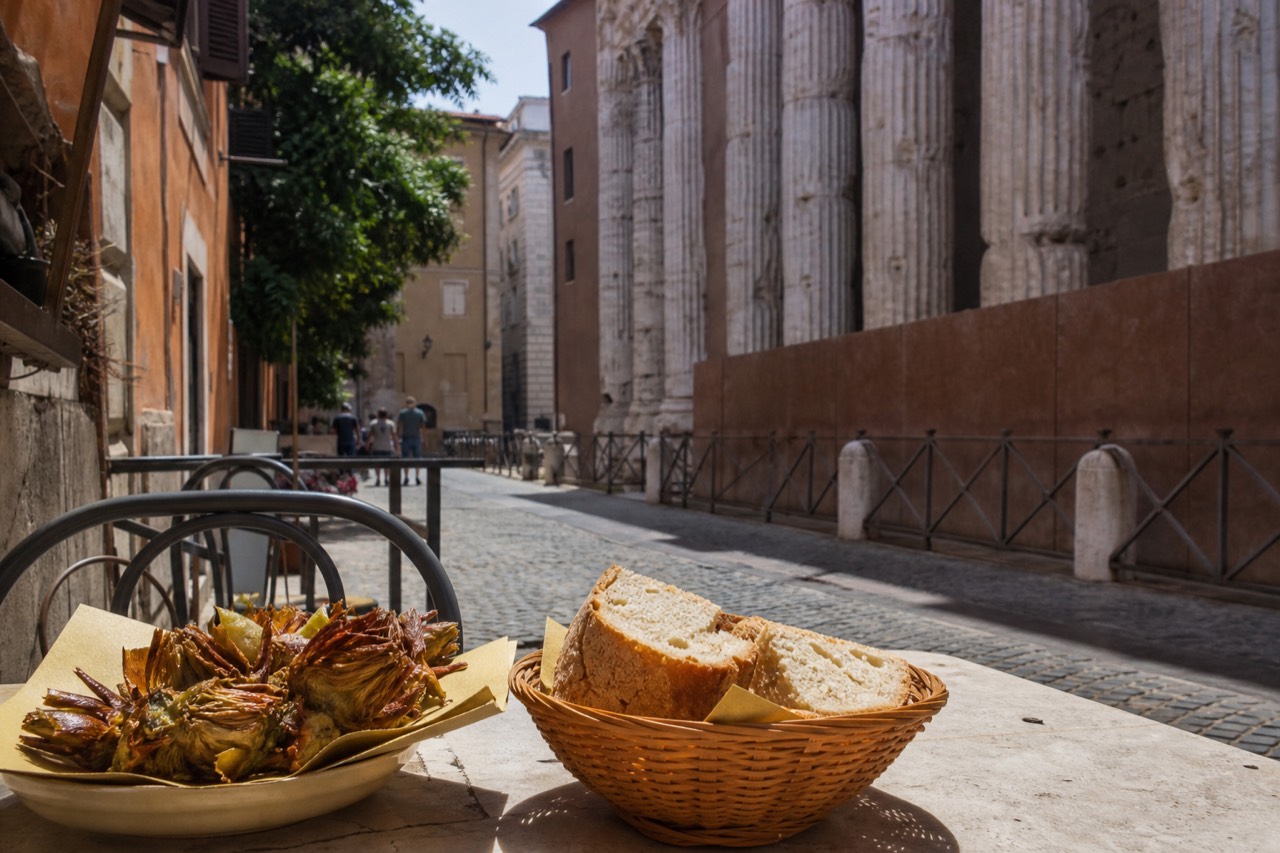
Rome's Jewish Ghetto centers on Via del Portico d'Ottavia, a few minutes from Campo de' Fiori and Largo di Torre Argentina. Its signature dish is carciofi alla giudia, deep-fried Roman artichokes. A food tour here typically costs $86 to $115 per person and pairs the quarter with Trastevere across the river.
The Jewish Ghetto of Rome is one of the oldest Jewish quarters in the world, older than almost every Jewish community in Europe, and it sits on a compact bend of the Tiber that most visitors cross without realizing what they are crossing into. The food is the reason to slow down. Carciofi alla giudia, the deep-fried whole artichoke that cracks open like a bronze chrysanthemum, exists nowhere else in this form. The kosher bakeries along Via del Portico d'Ottavia sell pizza ebraica and ricotta cakes that follow recipes older than the neighborhood's current buildings. And the quarter's food tours, unlike the Trastevere walks across the river, tend to fold in two neighborhoods at once, because the Ghetto alone is small enough to eat through in an afternoon.
This guide covers what the Ghetto is, what it eats, what a tour there actually includes, what it costs, and how it compares with the better-known options on the other side of the river. Everything priced here comes from live tour listings; everything historical comes from primary and official sources.
What is the Jewish Ghetto in Rome?
The Jewish Ghetto is the quarter of Rome established by papal decree on 14 July 1555, when Pope Paul IV's bull Cum Nimis Absurdum forced all Jews in Rome and the surrounding countryside into a fenced, flood-prone stretch of the Tiber's left bank. It lasted as a walled, gated zone until 1870, making it one of the longest-lived ghettos in Europe, and today it is a four-block food and heritage district centered on Via del Portico d'Ottavia.
The bull that created it did more than draw a boundary. Jews inside the new zone had to sell their houses and pay rent instead, wear a yellow sign, and keep no Christian servants; Jewish doctors could not treat Christian patients, and Jewish merchants could sell only used goods. All of this is documented by the Jewish Community of Rome itself, on its own history pages, which is the source of record for the quarter's early decades (Comunità Ebraica di Roma).
The walls came down in stages. Roman Jews received equal rights with the end of the Papal State in 1870, and the demolition of the old, unhealthy housing was decided in 1885 under the city's first master plan, using a national sanitation law. The Tempio Maggiore, the Great Synagogue that replaced the five small Scole of the ghetto period, was inaugurated in 1904. What visitors walk through today is therefore not the walled ghetto of the papal centuries but the quarter rebuilt above the river's flood level in the decades after 1885, with the street plan of the old zone partly preserved in Via del Portico d'Ottavia and the lanes around it.
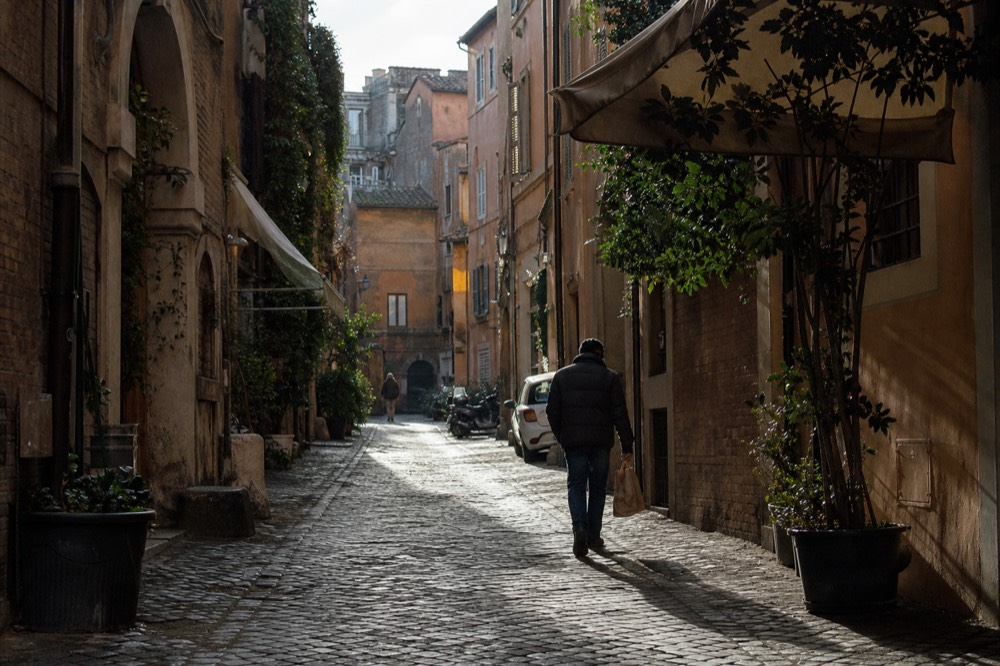
Roma Capitale's own tourism portal describes the site plainly: Rome's ghetto is among the oldest in the world, second only to Venice's of 1516 (Turismo Roma). For a food traveler the practical takeaway is size. The present Jewish quarter extends over about four blocks, crossed lengthways by Via Catalana and bounded by Via del Portico d'Ottavia on one side and the Tiber on the other. You can walk its full length in ten unhurried minutes, which is exactly why food tours here rarely stop at the neighborhood boundary.
What food is the Jewish Ghetto famous for?
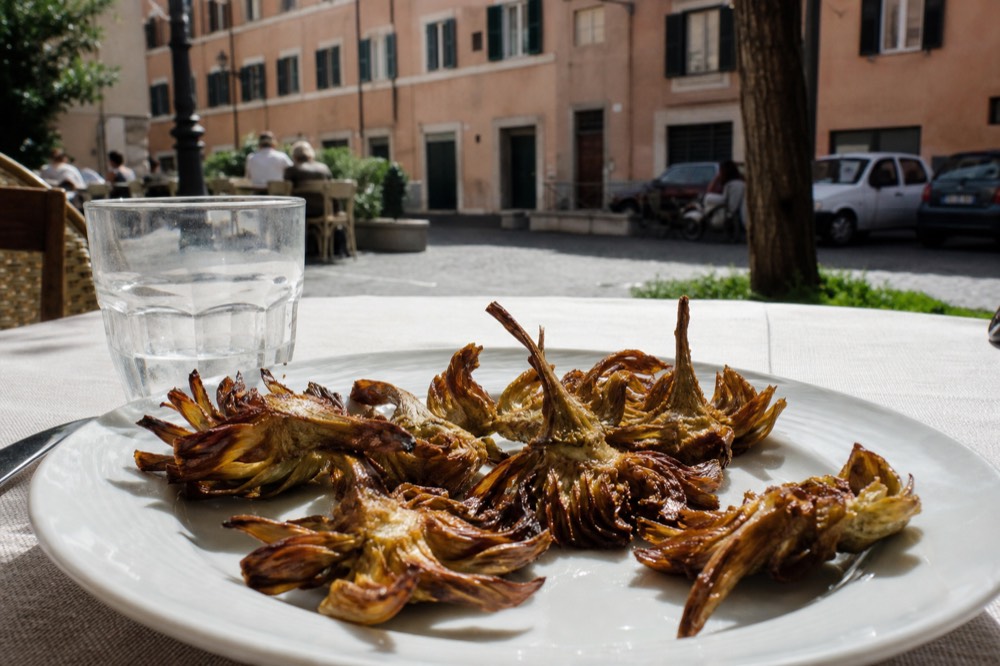
The Ghetto's signature dish is carciofi alla giudia, a whole Roman artichoke flattened and deep-fried in olive oil until the leaves crisp open like a flower. Around it sit the other giudaico-romana specialities: filetti di baccalà, salt cod fillets; tortino di aliciotti e indivia, an anchovy and endive bake; and crostata with visciole jam and ricotta, the sour-cherry tart of Roman Jewish kitchens.
The artichoke itself has a protected pedigree that most visitors never hear about. Carciofo Romanesco del Lazio is a registered PGI, grown from the Castellammare and Campagnano cultivars in named municipalities of the provinces of Viterbo, Rome and Latina, with a harvest that starts in January and can run into May depending on weather. That season matters: a carciofo alla giudia eaten in February is a different vegetable from one eaten in July, and the fried version only appears on Roman menus when the fresh Roman artichoke is in the market.
One honest caution. The origin story of carciofi alla giudia, the familiar tale of a 16th-century frying accident or of the ghetto's community teaching Rome to eat artichokes, is not documented by any institutional source. Roma Capitale's tourism pages name the dish as a speciality of the quarter today, and that is as far as the record reliably goes. Treat it as the quarter's defining dish, not as a dated historical anecdote.
The kosher bakeries on Via del Portico d'Ottavia carry the sweeter side of the tradition. Pizza ebraica, a dense, nut-and-candied-fruit confection that shares a name with pizza but nothing else, and ricotta-and-visciole crostata are the two to look for, alongside the breads baked under kosher supervision. The same street holds the restaurants that serve the fried artichokes, and in high season the queues for a table form well before the dinner hour.
The most practical way to eat all of this in one evening, with a guide who can tell the kosher bakeries from the tourist shops, is a guided walk. These are the three tours that cover the Ghetto most directly, from the two-neighborhood standard to a free-flowing luxury version.
What does a Jewish Ghetto food tour actually cover?
A typical Ghetto food tour runs 2 to 4 hours, meets within walking distance of Campo de' Fiori or Piazza Farnese, and strings together 8 to 20 tastings across the Jewish quarter and usually Trastevere as well. Guides cover the 1555 ghetto decree, the kosher food tradition, and the four classic Roman pastas alongside the tastings, with wine poured at most stops.
The best-reviewed tour in this family is the 15-tastings walk run by Gourmetaly, officially titled "Rome Food & Wine Tour: 15 tastings in Trastevere & Jewish Ghetto." It costs $86.37 per person, holds a 4.9 rating across 3,621 reviews, and runs between 2 hours and 3 hours 30 minutes. It meets at Via dei Baullari 106, on the corner of Piazza Farnese, which places the Ghetto leg of the walk within easy reach of Campo de' Fiori. Fifteen tastings is enough to cover the fried artichoke, the baccalà, a pasta course, the bakery stops and several pours of wine without rushing.
What distinguishes a Ghetto-including tour from a pure Trastevere one is the narrative, not just the calories. A guide walking you through Via del Portico d'Ottavia will explain what kosher supervision means for a bakery's output, why the quarter's frying tradition leans on olive oil, and how the giudaico-romana kitchen differs from the Roman one across the river. The quinto quarto offal cooking of Testaccio, for instance, belongs to the slaughterhouse district's history, not the Ghetto's, and a good guide will keep the two traditions straight rather than blending them into a generic "Roman food" story.
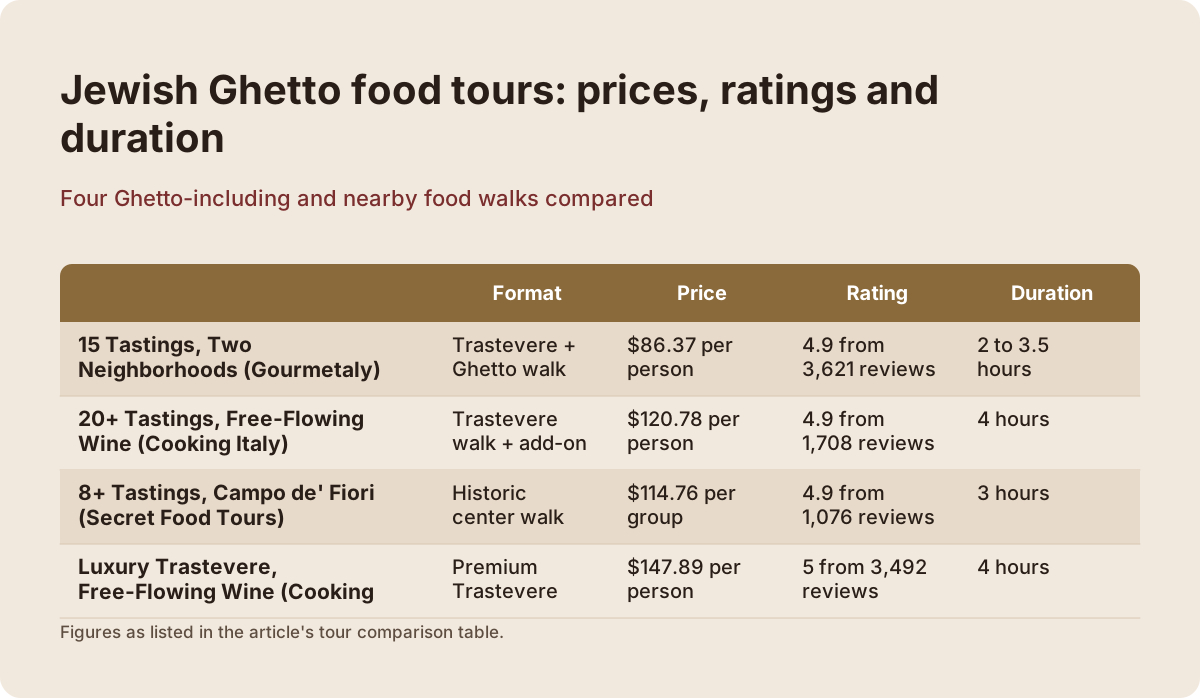
Tours in this family differ mostly in depth and format. The table below lays out the main options that include the Ghetto or pair naturally with it.
| Tour | Format | Price | Rating | Duration |
|---|---|---|---|---|
| 15 Tastings, Two Neighborhoods (Gourmetaly) | Trastevere + Ghetto walk | $86.37 per person | 4.9 from 3,621 reviews | 2 to 3.5 hours |
| 20+ Tastings, Free-Flowing Wine (Cooking Italy) | Trastevere walk, Ghetto optional add-on | $120.78 per person | 4.9 from 1,708 reviews | 4 hours |
| 8+ Tastings, Campo de' Fiori (Secret Food Tours) | Historic center walk near the Ghetto | $114.76 per group | 4.9 from 1,076 reviews | 3 hours |
| Luxury Trastevere, Free-Flowing Wine (Cooking Italy) | Premium Trastevere walk | $147.89 per person | 5 from 3,492 reviews | 4 hours |
A note on the third row: the Campo de' Fiori walk meets at Piazza Navona and works the historic center around the Ghetto's edge, so it suits travelers who want the neighborhood's food without a dedicated Ghetto-history narrative. If the 1555 story is the reason you are here, pick a tour that names the Jewish Ghetto in its itinerary explicitly.
How does a Ghetto food tour differ from a Trastevere one?
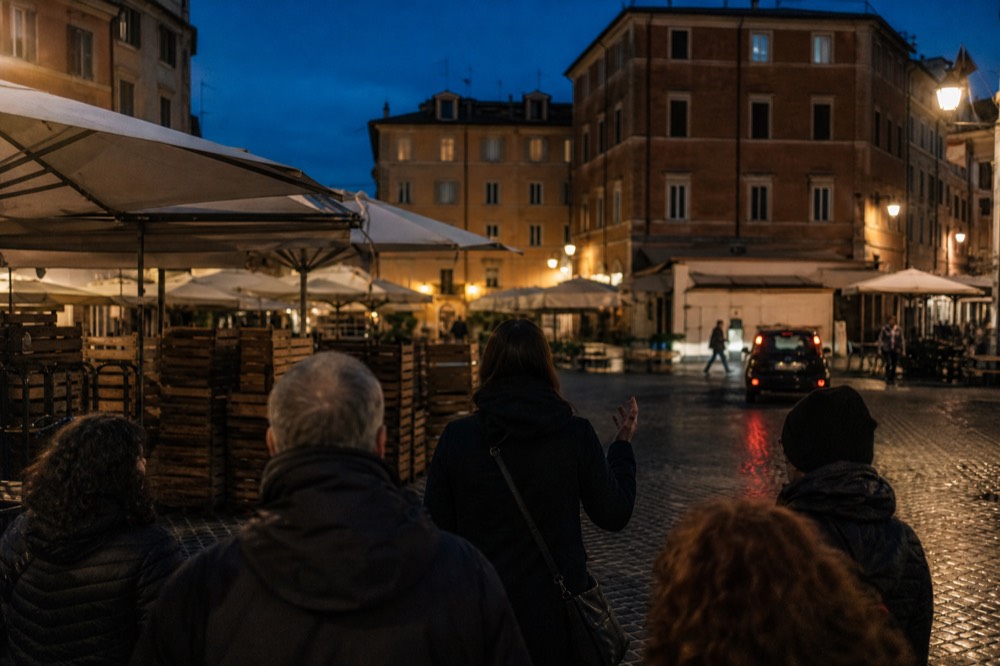
A Trastevere food tour stays in one riverside neighborhood and leans on Roman trattoria cooking, wine bars and street food; a Ghetto tour adds a second, smaller quarter with its own kosher food tradition and a heavier historical narrative. Ghetto-including tours also tend to start nearer the centro storico, while pure Trastevere walks cross the river first, and the two formats overlap most in their pasta and wine stops.
The contrast is easiest to see in the tour rosters. Trastevere-only options range from a $52.26 street food walk of 2.5 hours to a $123.04 four-hour twilight dinner tour, and their stops are the neighborhood's trattorias, wine bars and fried-supplì counters. The Ghetto-including walks, by contrast, almost all bill themselves as two-neighborhood tours, because the Jewish quarter alone is too compact to fill four hours of eating. Our dedicated Trastevere food tours guide breaks down that side of the river in detail.
The food itself diverges. Trastevere's kitchens run on the four classic Roman pastas, carbonara, cacio e pepe, gricia and amatriciana, plus the fried street foods of Roman popular cooking. The Ghetto's kitchen adds the giudaico-romana dishes: the fried artichoke, the baccalà, the anchovy-and-endive tortino, and the visciole-and-ricotta crostata. Amatriciana, incidentally, is the only one of the four pastas with a confirmed EU registration, a TSG whose specification requires 18 to 30 percent Amatrice pork jowl and states plainly that the sauce has always been made with guanciale, never bacon or pancetta.
Practically, the choice comes down to time and appetite. If you have one evening and want the postcard Rome of ivy and cobblestones, a Trastevere walk is the better fit. If you want the dish you cannot order anywhere else, carciofi alla giudia in its home quarter, you need a tour that crosses into the Ghetto, and the two-neighborhood format is the standard for a reason.
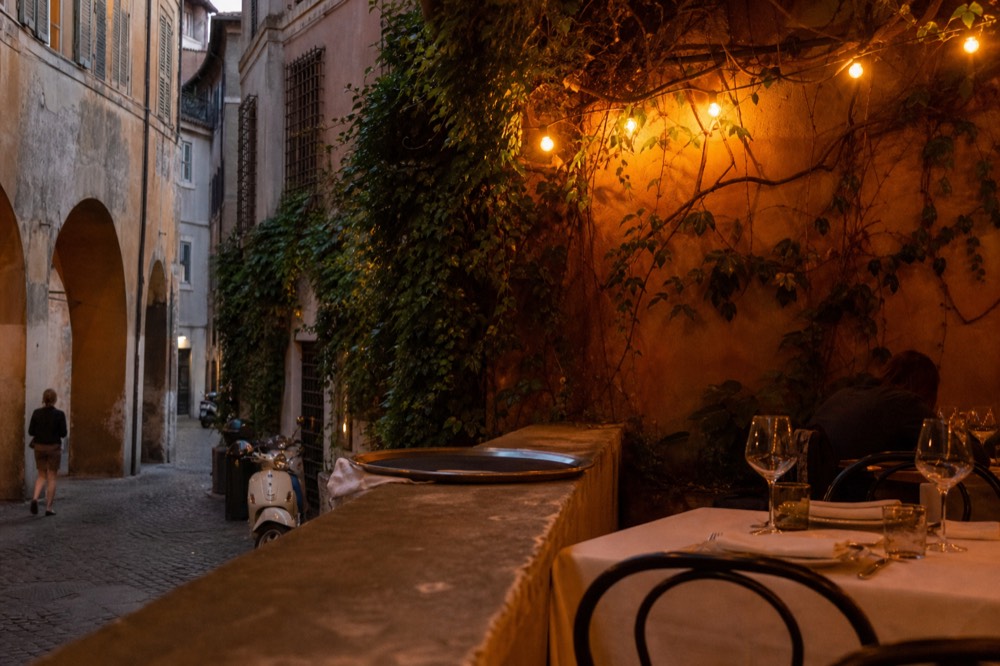
Where exactly do the tours eat? A street-by-street map
Almost every Ghetto food stop sits on or within one block of Via del Portico d'Ottavia, the quarter's main street, which runs from Largo di Torre Argentina toward the Tiber past the Great Synagogue. The parallel Via Catalana and the small piazzas off Piazza Costaguti hold the rest, and the whole eating district fits inside a rectangle you can cross on foot in under fifteen minutes.
Via del Portico d'Ottavia is the spine. The street takes its name from the ancient Porticus Octaviae, whose monumental remains still stand mid-street, and the Jewish Museum of Rome sits at its synagogue end. The kosher bakeries cluster here, and the restaurants famous for fried artichokes face onto it or onto the small squares immediately off it. A tour that lists Via del Portico d'Ottavia, Piazza Costaguti or Largo di Torre Argentina among its stops is genuinely working the quarter.
From there the geography is simple. Largo di Torre Argentina, with its excavated temple platforms, lies a few minutes to the northeast and is a common meeting point for centro storico tours. Campo de' Fiori, another frequent meeting point, sits just across the Corso Vittorio Emanuele II. And across the river, Trastevere begins at Ponte Sisto, which is why the two-neighborhood tours work so well: the bridge connects the Ghetto's edge to Trastevere's heart with a single pleasant walk along the water.
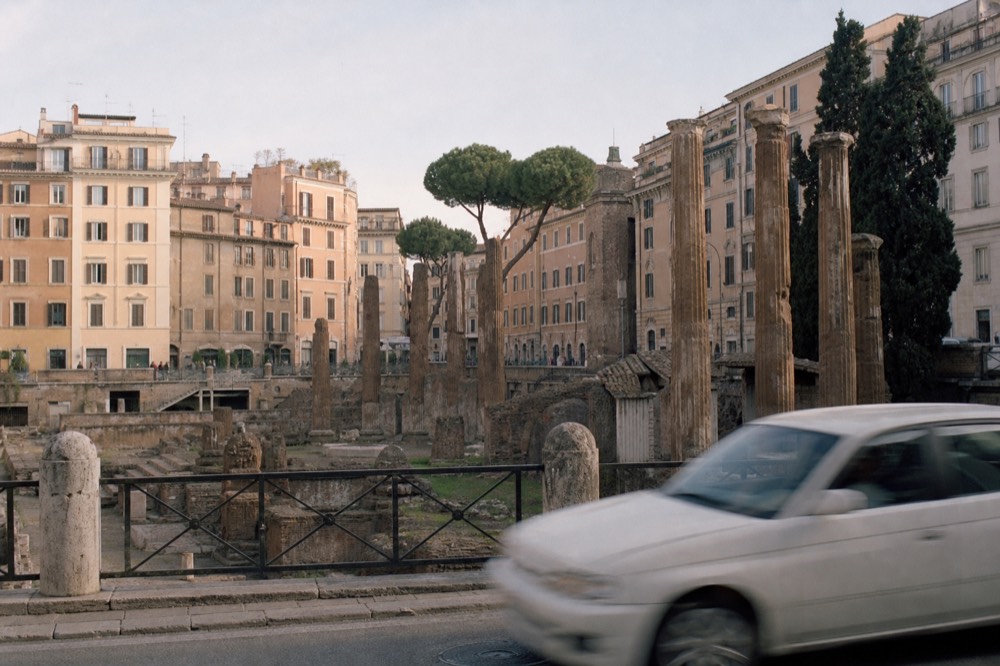
If you would rather explore the Ghetto on your own before or after a tour, the self-guided order that works is: start at Largo di Torre Argentina, walk down Via del Portico d'Ottavia past the ancient portico to the synagogue end, double back through Via Catalana, and finish with a gelato or a bakery stop before crossing to Trastevere. Our street food guide for Rome covers the fried snacks worth queueing for citywide, and the Testaccio food tours guide explains the market-and-offal tradition if you want the third face of Roman eating.
What do Jewish Ghetto food tours cost?
Ghetto-including food tours in Rome run from $86.37 per person for the 15-tastings walk to $147.89 per person for the luxury free-flowing-wine format, with the 15-tastings two-neighborhood tour as the most reviewed standard option. Prices are per person on the multi-tasting walks; a few historic-center tours quote per group instead, so check whether the listed price covers one guest or your whole party before comparing.
The price ladder is short and legible. At the base, the Gourmetaly 15-tastings tour at $86.37 per person is the reference point, with a 4.9 rating across 3,621 reviews. One step up, the 20-plus-tastings Trastevere walk with free-flowing wine costs $120.78 per person and runs four hours, and the luxury version with free-flowing fine wine tops the range at $147.89 per person with a perfect 5 rating across 3,492 reviews. Below the Ghetto-specific floor, the pure street food walks that skip the quarter start at $51.10 per person, but they do not include the fried artichoke or the kosher bakery stops.
What you get for the jump from $86.37 to $147.89 is mostly volume and wine. The luxury tour's listing promises free-flowing fine wine across four hours, which for a couple can represent the better per-glass value if you would otherwise order wine by the glass at each stop. What you do not get at any price is a private guide: these are small-group formats, and the private options in the city, such as the golf cart tour at $191.67 per group, trade the walking format for a vehicle and hotel-area pickup.
Two money notes that apply to eating in Rome generally. Lazio law prohibits a separate coperto charge at the table, and any service component has to appear on a price list you can see before ordering, so a restaurant adding a flat cover charge is out of line with the regional rule even if it happens. And the city's tourist tax, up to 10 euros per person per night depending on accommodation category, is collected by your hotel or host rather than included in a tour price, so it should not surprise you at checkout.
| Tour | Price basis | What the price includes |
|---|---|---|
| 15 Tastings, Two Neighborhoods | $86.37 per person | 15 food tastings plus wine, guide, Ghetto and Trastevere |
| 20+ Tastings, Free-Flowing Wine | $120.78 per person | 20+ tastings, free-flowing wine, 4-hour Trastevere walk |
| Luxury Trastevere, Free-Flowing Wine | $147.89 per person | Premium tastings, free-flowing fine wine, 4 hours |
| 8+ Tastings, Campo de' Fiori | $114.76 per group | 8+ tastings and wine, group price varies by size |
| 2.5-Hour Street Food Walk | $52.26 per person | Street food tastings, no Ghetto stops |
When is the best time to take a Ghetto food tour?
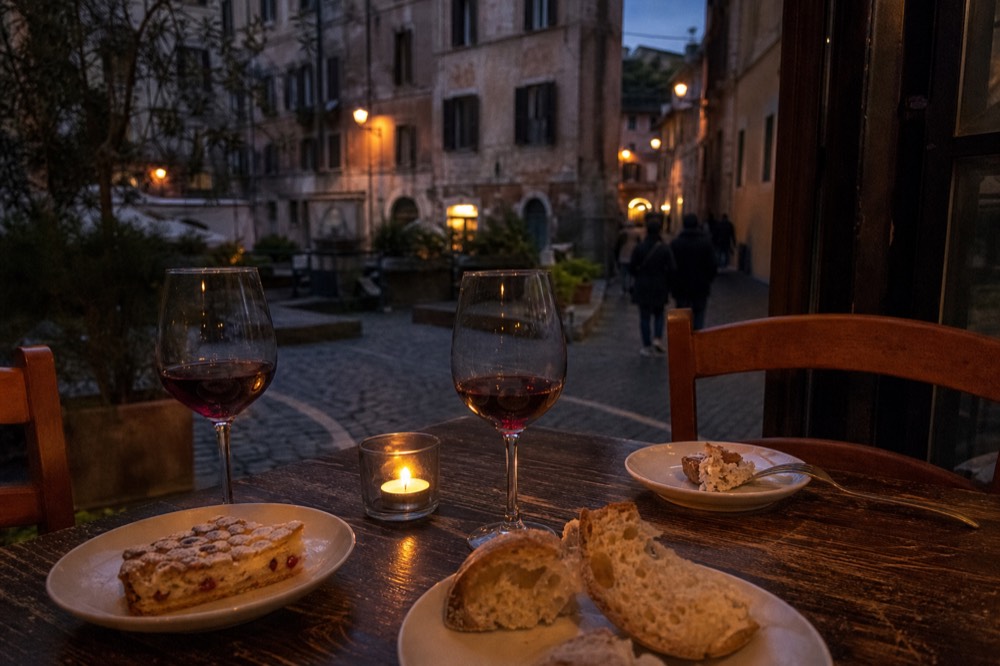
The best time for a Jewish Ghetto food tour is between January and May, when the fresh Roman artichoke is in season and carciofi alla giudia is on menus in its true form, and the best hours are late afternoon into evening, when the bakeries and restaurants are all open and the quarter's tables fill after the day-trippers leave. Avoid Saturday, when kosher establishments close for Shabbat.
The artichoke season is the whole argument. The Carciofo Romanesco del Lazio PGI harvest starts in January and can continue into May, and the fried giudia preparation depends on the fresh, tender Roman artichoke rather than the tougher year-round varieties. A tour in March or April gives you the dish at its best; a tour in August gives you a menu that substitutes or omits it, plus the general Roman complication of chiuso per ferie closures, which are a custom rather than a legal rule.
Saturday matters more here than anywhere else in Rome. The quarter's kosher bakeries and kosher-supervised restaurants observe Shabbat, so a Saturday tour loses some of its stops even when the non-kosher restaurants on the street stay open. Friday evening runs into the same issue as the Sabbath begins at sundown. Sunday and weekday evenings are the reliable windows.
| Period | Artichoke season | What to expect on a Ghetto food walk |
|---|---|---|
| January to May | Peak, PGI harvest running | Carciofi alla giudia at its best; book ahead, tables fill |
| June to July | Ending or over | Fried artichoke substituted or omitted on many menus |
| August | Out of season | Chiuso per ferie closures possible; night traffic zones switched off |
| September to December | Out of season | Full bakery and restaurant offer; fewer artichoke queues |
| Friday evening and Saturday | Season irrelevant | Kosher stops close for Shabbat; tour loses stops |
Evening tours have a second advantage beyond opening hours. The Ghetto's dining rooms are small, and the dinner hour fills them; a tour with reserved tables sidesteps the queue that walk-ins face for the artichoke restaurants in high season. If your dates are fixed around a Saturday, flip the plan: do the Ghetto on another evening and spend the Saturday in Trastevere or Testaccio, whose kitchens keep different rhythms.
Practical rules that affect a Ghetto food walk
Three local rules shape a food walk in and around the Ghetto: Rome's urban police regulation bans sitting to eat on monuments and fountain steps, with a reduced-payment fine of 250 euros attached; Lazio law prohibits a separate coperto charge at the table; and the Trastevere night traffic zone, active Friday and Saturday from 21:30, affects any tour vehicle picking up across the river. None of these restricts a walking tour's tastings themselves.
The sitting rule is the one that catches visitors. The city's urban police regulation, in force since 2019, prohibits sitting, including while eating or drinking, on historic and artistic heritage, and the text names fountains and their steps specifically, as well as sitting on public ground outside equipped eating spaces. The reduced-payment amount attached to that behavior is 250 euros. On a food walk this matters at the scenic stops: the steps of the Porticus Octaviae remains and the edges of the Tiber embankment are exactly the kind of perch the rule covers, so eat at the stops, not on the ruins.
The coperto rule works in your favor. Under Lazio regional law, a restaurant may not add a separate cover charge, and any service charge must be shown on the price list before you order. The law is the rule rather than a guarantee of compliance, but knowing it makes an unexplained coperto line on a bill a legitimate query rather than a mystery. Tipping is separate and voluntary; a survey of 192 tour operators found Americans are the world's most generous tippers, so Roman servers are used to American-style rounding up, but no tip is obligatory.
For vehicle-based options, the night ZTL in Trastevere operates Friday and Saturday from 21:30 to 03:00, and from May to October also on Wednesday and Thursday, with a 30 km/h speed limit inside. A walking tour is unaffected; a golf cart or private car tour that picks up or drops off in Trastevere in those windows needs a permitted driver. Late-night takeaway alcohol sales are also restricted in the central nightlife zones from 22:00, which is one more reason the licensed-terrace format of a food tour is the simpler evening plan.
Which Ghetto food tour should you book?
Book the 15-tastings Trastevere and Jewish Ghetto walk at $86.37 per person if you want the standard, most reviewed Ghetto experience; the 20-plus-tastings free-flowing-wine tour at $120.78 if food volume is the priority; and the luxury free-flowing fine wine tour at $147.89 if you want the premium version. Travelers on a tight budget should pair a self-guided Ghetto walk with the $52.26 street food tour elsewhere in the center.
The decision tree is short. One evening in Rome, want the artichoke: the 15-tastings walk, which is the only tour of the three that names the Jewish Ghetto in its official title. Big appetite, four hours to spend: the 20-plus-tastings tour, which trades the Ghetto narrative for sheer quantity and wine that keeps coming. Celebration dinner on a trip: the luxury tour, whose 5 rating across 3,492 reviews is the strongest signal in the premium bracket.
Budget travelers have a real option, not a consolation prize. The Ghetto is compact and walkable, and a self-guided visit with a stop at a bakery and a shared fried artichoke costs a fraction of any tour. Pair that with the 2.5-hour street food walk at $52.26 per person, which covers Campo de' Fiori and the centro storico with a guide, and you have eaten both traditions for less than the price of one premium tour. What you give up is the queue-jumping and the historical narrative, which in this particular quarter is a real loss: the 1555 story is the kind of context a guide earns their fee explaining.
For travelers weighing Rome against a cooking class instead, the class route teaches you to make the four pastas but never introduces you to the giudaico-romana kitchen, which is restaurant and bakery food rather than home cooking. The two formats answer different questions, and our cooking classes in Rome guide covers the other half of that choice.
Whichever direction you take, the underlying case for this quarter over the more famous food neighborhoods is simple, and it is the reason this site, Rome Food Tours, gives the Ghetto its own guide: it is the only place in the city where the food on the plate and the history of the street come from the same community, continuously, for more than four centuries.
If you are comparing across formats before you commit, these are the three tours this guide keeps returning to.
These are the questions travelers ask most about eating in and touring Rome's Jewish quarter, answered with the tour prices and season figures verified for this guide. The short version: the fried artichoke is seasonal, the tours pair the Ghetto with Trastevere by design, and Saturday is the one day that genuinely undercuts the experience.
Common questions about Jewish Ghetto food tours in Rome
What is the Jewish Ghetto in Rome famous for food-wise?
The fried whole artichoke, carciofi alla giudia, plus filetti di baccalà, tortino di aliciotti e indivia, and crostata with visciole jam and ricotta. Roma Capitale names all of these as giudaico-romana specialities of the quarter, and the kosher bakeries on Via del Portico d'Ottavia carry the sweet side of the tradition.
How much does a Jewish Ghetto food tour cost?
Ghetto-including tours run from $86.37 per person for the 15-tastings two-neighborhood walk to $147.89 per person for the luxury free-flowing-wine format. Street food walks that skip the Ghetto start at $51.10 per person, and one historic-center tour quotes $114.76 per group with the price varying by group size.
Is the Jewish Ghetto worth visiting for food?
Yes, if the fried artichoke and the kosher bakery tradition are what you want, because neither exists in this form elsewhere in Rome. The quarter is small, about four blocks, so most food tours pair it with Trastevere across the river to fill out the walking time and the tasting count.
When is carciofi alla giudia in season?
The Carciofo Romanesco del Lazio PGI harvest starts in January and can run into May, depending on weather. The fried giudia preparation depends on the fresh Roman artichoke, so menus in high season outside that window serve a substitute or omit the dish.
Can you walk through the Jewish Ghetto on your own?
Yes, easily. The quarter fits in a fifteen-minute walk, with Via del Portico d'Ottavia as the spine and the ancient Porticus Octaviae remains mid-street. A guided tour adds the 1555 history, the kosher context and reserved tables at the artichoke restaurants, which matters most in peak season.
Do Ghetto food tours run on Saturdays?
They can run, but Saturday is the weakest day for this specific quarter because kosher bakeries and kosher-supervised restaurants close for Shabbat. Friday evening runs into the same issue at sundown. Book the Ghetto leg on a Sunday or a weekday evening if you can.